
From December 11 to 12, 2025, Professor Jean-Michel Rabaté, Fellow of the American Academy of Arts and Sciences and a leading scholar in contemporary literary theory and intellectual history, was invited to visit the School of Humanities at Shanghai Jiao Tong University. Centered on key issues in contemporary humanities scholarship—including post-theory and Derrida’s intellectual legacy—Professor Rabaté delivered two high-level academic lectures. This lecture series forms an important part of the “Academician Lecture Series” organized by the Institute of Arts and Humanities, which aims to introduce world-class scholars, foster high-level academic dialogue, and continuously promote the exchange and innovation of humanities scholarship at SJTU and in China within a global context.

The December 11 session, titled “The Future of Post-Theory: New Disciplines and New Tasks,” was held in the form of an academic dialogue. Professor Rabaté engaged in an in-depth discussion with Professor Wang Ning, Fellow of the Academia Europaea, from diverse intellectual perspectives, with the dialogue moderated by Professor Shang Biwu, also a Fellow of the Academia Europaea. Drawing on his major works The Future of Theory (2002) and Theory Across Disciplines (2025), Professor Rabaté argued that the era of “Theory” with a capital “T”—characterized by closed systems and singular paradigms—has come to an end. Theory itself, however, has not disappeared; instead, it has entered new fields of inquiry in more open and fluid forms. In contemporary humanities scholarship, theory continues to “overflow” into areas such as environmental humanities, medical humanities, gender and sexuality studies, law and literature, religious studies, systems theory, global sociology, and world-systems theory, where it is reactivated through interdisciplinary practice. Drawing on his research on “fashion theory,” Rabaté further illustrated Derrida’s notion of theoretical “overflow,” emphasizing how theory continuously generates new problematics within evolving epistemic contexts.
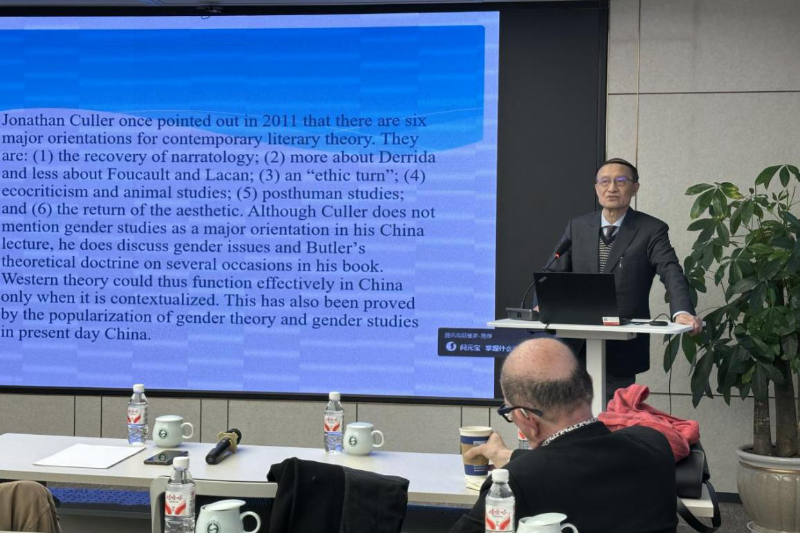
Professor Wang Ning followed with a presentation titled “Literary and Cultural Studies in the Post-Theory Era.” He observed that Western thought has entered a post-Derrida/post-theory phase, in which literary theory no longer exists as a self-contained system, yet continues to exert influence through interdisciplinary and cross-cultural trajectories. Taking the transmission and transformation of Judith Butler’s gender theory in the Chinese context as an example, he explored how theories are reconfigured through cross-cultural circulation, producing new academic meanings and social effects. Both scholars reached a shared and thought-provoking consensus: post-theory does not signal the withdrawal of theory, but rather its ongoing reshaping through new disciplines, new questions, and new intellectual missions.
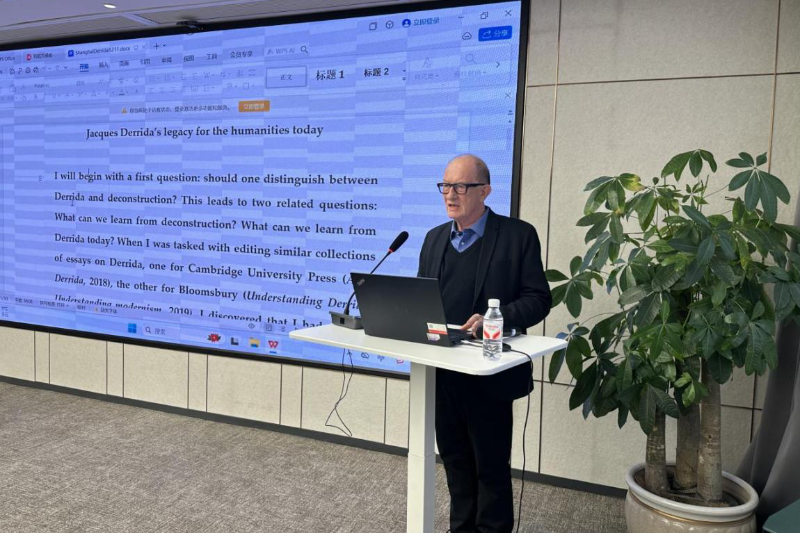
On December 12, Professor Rabaté delivered a second lecture titled “Derrida’s Legacy: From Autobiography to Auto-Theory.” From the dual perspectives of intellectual history and close textual reading, he systematically examined Derrida’s enduring significance in contemporary humanities scholarship. Distinguishing between “deconstruction” as a theoretical label and “Derrida” as a thinker in practice, Rabaté emphasized the necessity of returning to Derrida’s own writing and teaching in order to grasp the openness and unfinished nature of his intellectual legacy, especially as deconstruction has become increasingly institutionalized. Rabaté devoted particular attention to Derrida’s institutional understanding of literature, arguing that literature is not an a priori aesthetic object, but a historical construct closely tied to modern democratic institutions, grounded in the principle of the right to say everything. In this sense, literature functions not only as an aesthetic practice, but also as a public space imbued with profound political and ethical dimensions.
Addressing the increasingly influential phenomenon of auto-theory, Rabaté further noted that Derrida’s legacy does not simply legitimize self-expression, but instead offers a rigorous yet open critical ethics: one that upholds philological close reading and genealogical analysis of concepts, while resisting the reduction of literary works to mere illustrations of theory; one that acknowledges the role of subjective experience in theoretical production, yet avoids slipping into subjectivism or relativism. This mode of thinking—constantly moving between literature and philosophy—constitutes the most vital and enduring aspect of Derrida’s legacy today.
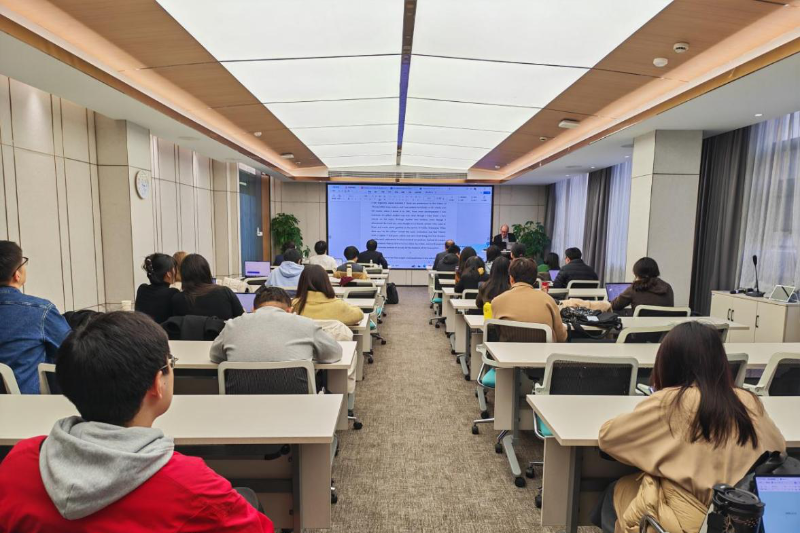
As a key component of the Academician Lecture Series long promoted by the Institute of Arts and Humanities, Professor Rabaté’s visit not only wove together two major threads of contemporary intellectual history—post-theory and Derrida’s legacy—but also embodied an open and international scholarly ethos through the combination of dialogues between Chinese and international academicians and specialized lectures. By continuously introducing world-class scholars and building high-level platforms for academic exchange, the Institute of Arts and Humanities at Shanghai Jiao Tong University continues to deepen its engagement with the international academic community, further enhancing the University’s global influence and academic reputation in the humanities, and laying a solid foundation for the development of a humanities hub with a global vision and a Chinese intellectual stance.
Author: Dong Jianxin
Contributing Unit: Institute of Arts and Humanities
Editor: Sun Jia
Translated by: Denise
Proofread by: Zara
